
A Practical Ingredient Checklist for Dog Joint Supplements
By the Kollavia editorial team. Updated October 2026.
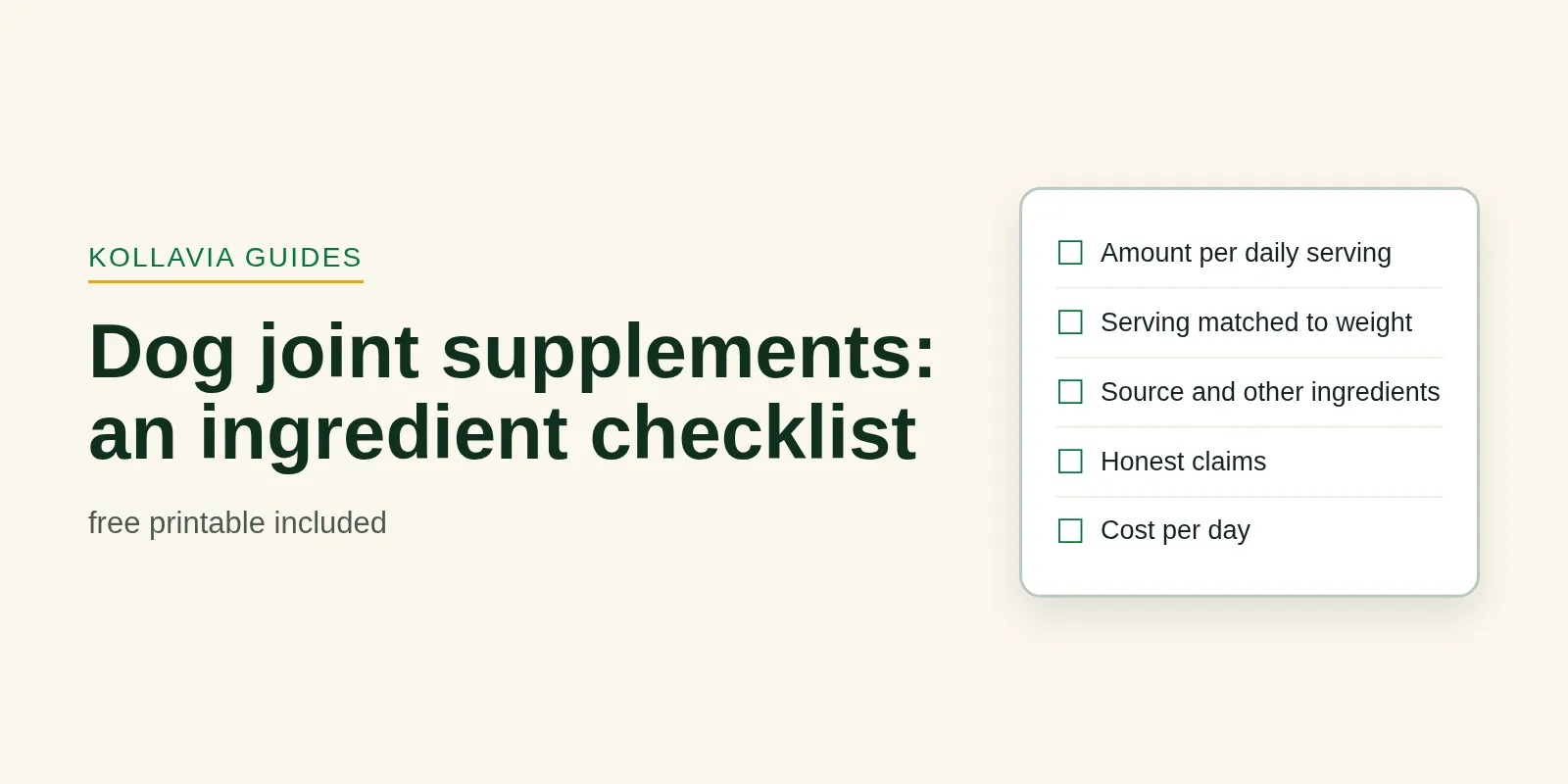
The pet shop shelf is full of dog joint supplements, and their labels are written to sell, not to compare. This checklist is meant to be used with any product, ours included. Work through it with the label in your hand, then take your notes to your vet. A printable version is at the end.
Before you buy anything
If your dog is slowing down, stiff after rest, limping or reluctant to jump or use stairs, book a check-up first. The vet charity PDSA lists these among the signs of arthritis, and notes that signs often appear gradually, so they are easy to miss (PDSA on arthritis in dogs). The same page says joint supplements are not a replacement for medication and do not work for every dog.
The checklist
| # | Check | What to look for |
|---|---|---|
| 1 | Amount per daily serving | The label should give amounts per serving and say what a serving is. Turn per-chew or per-ml figures into a total for one day. |
| 2 | Serving matched to your dog | Directions by weight band, in units you use (lb or kg). One-size-fits-all directions make it hard to compare. |
| 3 | Named actives with amounts | Each active ingredient listed with a number. "Proprietary blend" without amounts tells you nothing about what your dog gets. |
| 4 | Form of each ingredient | For example glucosamine HCl or sulfate, which type of collagen, which fatty acids and how many milligrams of each. |
| 5 | Where animal ingredients come from | Bovine, marine, poultry or shellfish. Matters if your dog has a known food sensitivity. |
| 6 | Everything else in the bottle | Flavourings, sweeteners, fillers. Xylitol is dangerous to dogs, causing low blood sugar and liver injury (ASPCA), so read the whole ingredient list. |
| 7 | A quality signal you can verify | In the US, the NASC Quality Seal means the supplier passed an independent audit (NASC). Otherwise, ask the maker for batch test results and see what they send. |
| 8 | Honest claims | A label that promises to treat or prevent a disease is making a drug claim. In the US the FDA treats such a product as a drug (FDA). |
| 9 | Your dog's situation | Medication, allergies, other conditions, pregnancy. Tell your vet what you plan to give. |
| 10 | A trial plan | Pick a start date, decide what you will watch for, and agree a review date with your vet. |
| 11 | Cost per day | Price divided by the days the product lasts at your dog's dose. |
| 12 | Return terms | Read the guarantee or refund policy before you order. |
What the research says
Be prepared for a sober answer. A systematic review in the Journal of Veterinary Internal Medicine looked at controlled trials of nutraceuticals for osteoarthritis in horses, dogs and cats, and found that the strength of evidence was low for all of them except omega-3 fatty acids in dogs (Vandeweerd et al., 2012). A 2022 systematic review and meta-analysis of 57 articles in dogs and cats found a clear pain-relief effect for omega-3 enriched diets, omega-3 supplements and, to a lesser degree, cannabidiol, but only weak efficacy for collagen and no clear effect for the combination of chondroitin and glucosamine (Barbeau-Gregoire et al., 2022). An earlier commentary in JAVMA described the clinical trial evidence for glucosamine and chondroitin in dogs as very weak (McKenzie, 2010).
None of that means a supplement cannot suit your dog. It does mean you should not expect a label to prove a result, and that you should judge a product by what you can check, such as the amounts, the ingredients, the source and the terms.
Where Kollavia fits
Run our own product through the same list. Kollavia Liquid Collagen for Dogs comes in a 60 ml bottle. Each 2 ml serving contains 400 mg hydrolyzed collagen types I, II and III from pasture-raised, grass-fed bovine, 20 mg glucosamine HCl and 10 mg hyaluronic acid. The daily amount is 1 to 4 ml by body weight, which our serving guide turns into a table in pounds and kilograms. Its label lists no chondroitin and no omega-3 fatty acids, so ask your vet whether your dog needs anything alongside it. It carries a money-back guarantee.
Questions to bring to your vet
- What do you think is behind my dog's change in movement?
- Should I try a supplement, and if so which active ingredients and at what daily amount?
- Is my dog at a healthy weight, and what should I change?
- Does anything my dog already takes interact with what I am considering?
- When should we review how it is going?
Download the checklist
Download the printable checklist (PDF). Two pages. The checklist above with tick boxes, and a two-week mobility notes sheet to fill in for your vet appointment. Free to print and share. If you republish it, a link back to this page is appreciated.
If you only want help reading one label, start with the serving guide; for formats, see liquid collagen vs chews for dogs.
Sources
- PDSA: Arthritis in dogs
- Vandeweerd JM et al. Systematic review of efficacy of nutraceuticals to alleviate clinical signs of osteoarthritis. J Vet Intern Med 2012
- Barbeau-Gregoire M et al. A 2022 systematic review and meta-analysis of enriched therapeutic diets and nutraceuticals in canine and feline osteoarthritis. Int J Mol Sci 2022
- McKenzie BA. What is the evidence? Glucosamine and chondroitin for osteoarthritis in dogs. J Am Vet Med Assoc 2010
- FDA: regulation of pet food
- National Animal Supplement Council
- ASPCA: Xylitol, the sweetener that is not so sweet for pets
About this guide
Written by the Kollavia editorial team. Kollavia sells one of the products this checklist can be used on, so we have listed the studies that are least flattering to supplements as well as the ones that are not. This guide is general information and not veterinary advice.
 -29%
Liquid Collagen for Dogs — Hip, Joint & Mobility Support
Collagen types I, II, and III, glucosamine, and hyaluronic acid.