
Dog Itchy Skin? What to Track Before Your Vet Visit
By the Kollavia editorial team. Updated October 2026.
Dog itchy skin is one of the most common reasons owners phone the vet, and one of the hardest to explain in a five-minute appointment. "He scratches a lot" does not give your vet much to work with. A two-week diary does. This guide covers what to write down, when not to wait, and what the vet is likely to look for first.
Itching is a sign, not a diagnosis
The Merck Veterinary Manual puts it plainly. Itching is a sign and not a specific disease, and its most common causes are parasites, infections and allergies. It also notes that by the time itching develops, the original cause may be long gone (Merck Veterinary Manual on itching in dogs). PDSA lists fleas, skin allergies, mites and lice, bacterial and yeast infections, reactions to medicines, cleaning products or washing powder, hot spots, wounds and ringworm among the causes (PDSA on itchy skin in dogs). Treating the wrong one wastes weeks, which is why the cause matters more than the cream.
When not to wait
PDSA says scratching is not normal if it happens regularly (more than four or five times a day) or comes with other signs, such as hair loss, pain, self-inflicted wounds, red or rashy skin, saliva-stained fur, or dark, thickened skin. Some dogs scratch or lick in private, so secret itching is worth watching for. A suspected severe allergic reaction, with hives, rashes or swelling, is an emergency. Contact your vet immediately (PDSA on dermatitis in dogs). Do not try home remedies before you know the cause, because the right treatment depends entirely on it.
What to track for two weeks
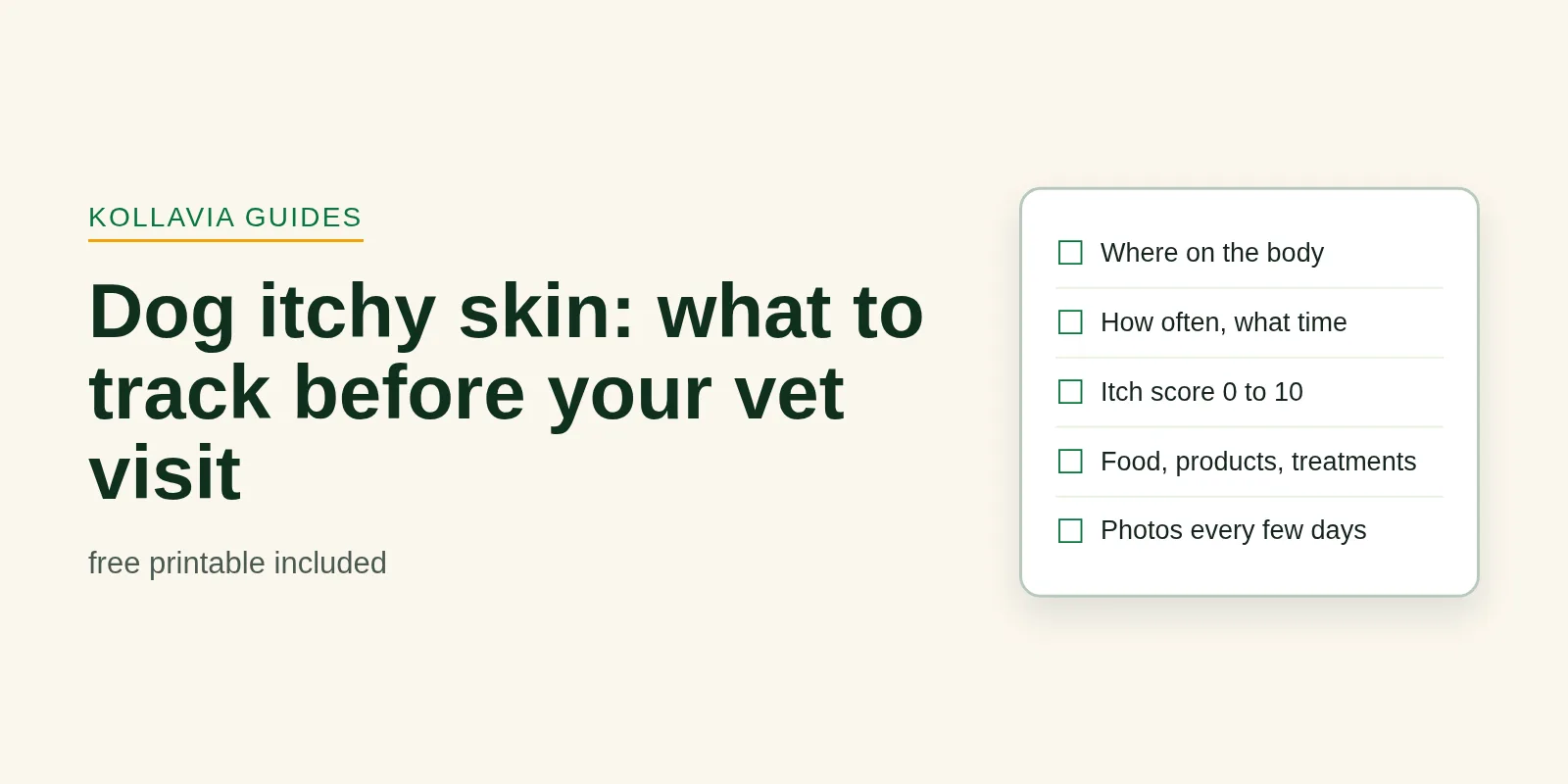
| What | Why your vet wants it |
|---|---|
| Start date, and whether it came on suddenly or slowly | Separates a new problem from a long-running one |
| Where on the body, such as paws, ears, belly, armpits, base of the tail, face | The pattern points toward different causes |
| How often your dog scratches, licks or chews, and at what times | Gives a baseline to compare against later |
| An itch score from 0 (none) to 10 (cannot settle), once a day | Shows whether things are getting better or worse |
| Sleep: does the itching wake your dog or you? | Shows how much it affects daily life |
| Season, weather and where you walked | Merck notes that seasonal itching suggests seasonal allergens |
| Food, treats, chews and any recent changes | A food allergy is confirmed or excluded with a diet trial, so your vet needs the full list |
| Flea and worm treatment, product name and last date | Parasites are the first thing a vet tries to exclude |
| Baths, shampoos, new bedding, cleaning products, washing powder | Contact reactions are a known cause (PDSA) |
| Everything your dog takes, including supplements, with the start date | Lets your vet see what changed and when |
| What the skin looks like, such as redness, hair loss, scabs, scaling, odour, discharge | Infections often bring odour, scaling or discharge |
| A photo every few days in the same light | Memory is a poor judge of slow change |
Researchers have validated owner-scored itch scales for dogs (Hill et al., 2007). The 0 to 10 score above is our own simple version, not a validated tool, but a daily number is still more useful than a feeling.
What your vet will probably do
Merck describes the usual order as a detailed skin history and a physical examination, then parasites first, then infection, then allergy. If an infection is suspected, a course of antibiotics may be tried, and if the itching continues afterwards, allergy becomes the likely cause. Food allergy is confirmed or excluded by response to a diet trial. Veterinary dermatology guidelines for atopic dermatitis describe treatment in two phases, first calming existing itch and skin lesions, then maintaining remission, and they stress that secondary infections and flare factors have to be dealt with too (ICADA guidelines, 2026).
One practical tip. Change one thing at a time, and write it down. If you switch food, shampoo and flea treatment in the same week, nobody can tell which one made the difference.
Where supplements fit
A supplement is not a treatment for itching, allergies or a skin infection, and none of the guidance above suggests otherwise. If you are thinking of adding one, such as a daily collagen product, do it after the vet visit and write the start date in the diary. For reference, Kollavia Liquid Collagen for Dogs contains 400 mg hydrolyzed collagen types I, II and III, 20 mg glucosamine HCl and 10 mg hyaluronic acid per 2 ml, with a daily amount of 1 to 4 ml by weight; our serving guide explains how to read that label, and the product page has the full formula. It comes with a money-back guarantee.
Download the itch diary
Download the printable itch diary (PDF). One page with a two-week grid for scratching, itch score, food and treatments, plus the questions to take to your vet. Free to print and share. If you republish it, a link back to this page is appreciated.
If your dog is also slowing down or stiff, our joint supplement checklist has a notes sheet for that.
Sources
- Merck Veterinary Manual on itching (pruritus) in dogs
- PDSA: Itchy skin in dogs
- PDSA: Dermatitis in dogs
- Hill PB, Lau P, Rybnicek J. Development of an owner-assessed scale to measure the severity of pruritus in dogs. Vet Dermatol 2007
- Mueller RS et al. Treatment of canine atopic dermatitis, updated guidelines from ICADA. Vet Dermatol 2026
About this guide
Written by the Kollavia editorial team. We sell a supplement, so we have kept this guide to what veterinary sources say and have not presented our product as a treatment. It is general information and not veterinary advice.
 -29%
Liquid Collagen for Dogs — Hip, Joint & Mobility Support
Collagen types I, II, and III, glucosamine, and hyaluronic acid.